
Turn your 2-year green card into a 10-year card
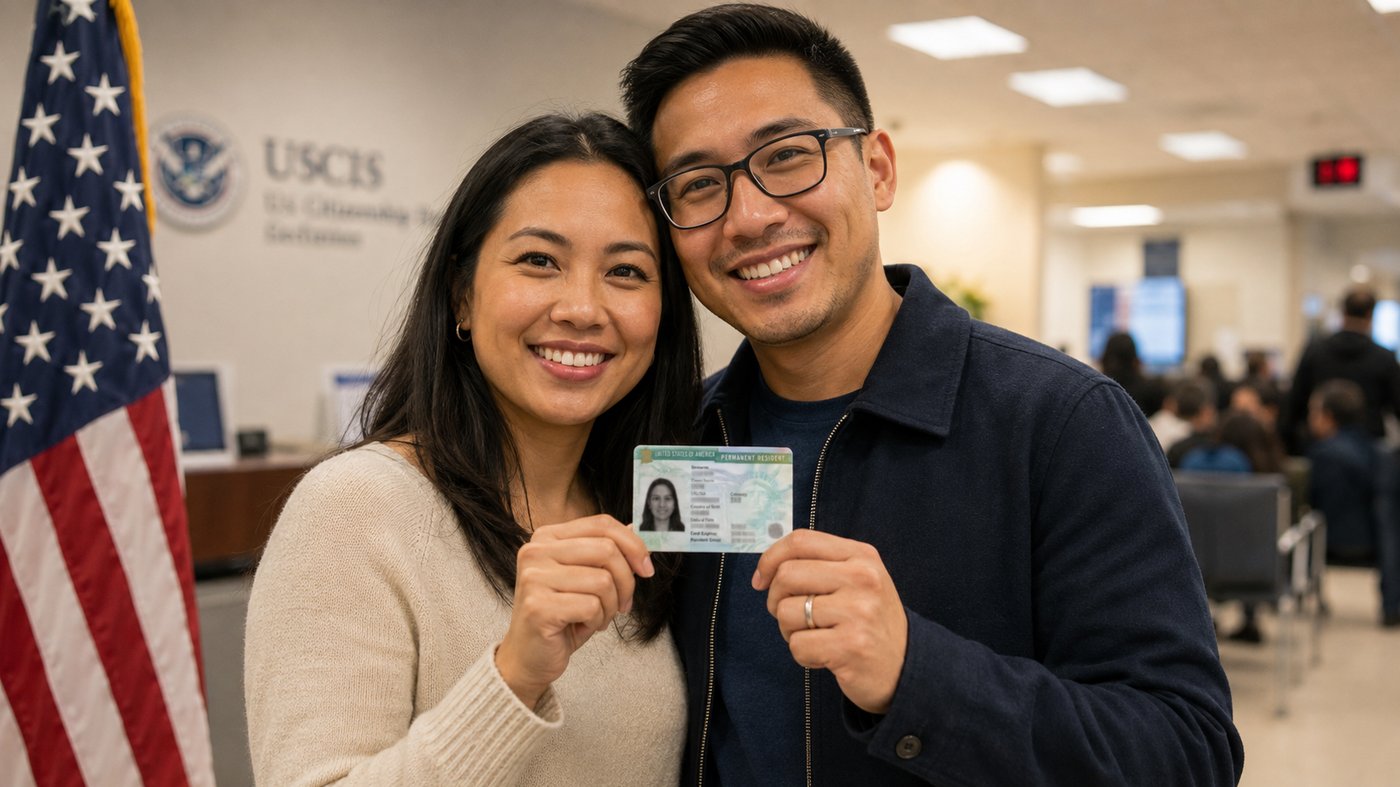
If you got your green card through a marriage that was less than two years old when it was approved, your card is conditional — good for two years, not ten. To make it permanent, you and your spouse file Form I-751 together in the months before it expires. We build the evidence, file the package, and stay with you through any interview, for one flat fee.
These are our base flat fees. They cover a standard case, start to finish, quoted in writing before you commit. More complex matters — and Stokes interviews, or attorney travel outside the NYC metro area or South Florida — are quoted separately. Government filing fees are set by USCIS and the State Department and are not included. Filing alone with a waiver of joint filing is $7,000.
What removing conditions means
When a marriage is less than two years old on the day your green card is approved, USCIS issues a conditional permanent resident card. It looks and works like any green card, but it carries an expiration date two years out. The condition is a built-in checkpoint: before the card runs out, you have to show that the marriage was real and not entered into to get around immigration law.
You do that by filing Form I-751, Petition to Remove Conditions on Residence. The window to file is the 90 days before your card expires — that date is printed right on the card. When USCIS accepts the petition, it sends a receipt notice that extends your permanent resident status for 48 months past your card's expiration while the case is pending, so you can keep living, working and traveling on lawful status even after the card's printed date passes. Once it's approved, the condition comes off and you receive a standard 10-year green card.
General information, current as of July 2026. Rules and timelines change — confirm specifics with counsel and the official source before you file.
How it works
1 Confirm your 90-day window
We read the expiration date on your conditional card and pin down the exact day your filing window opens. Filing too early can get a petition rejected; filing too late creates problems — so timing comes first.
2 Build the evidence package
Together we gather the proof that your marriage is genuine — joint finances, a shared home, a life built side by side — and organize it into a clean, consistent record an officer can follow.
3 File with USCIS & track
We prepare and submit Form I-751, confirm USCIS issues the receipt that extends your status for 48 months, and keep an eye on the case as it moves so nothing slips. As of mid-2026, I-751 petitions commonly take around 32–39 months to decide — the long extension exists precisely because of that wait.
4 Interview (if scheduled) & approval
USCIS may decide your case on the papers or call you in for an interview. If they do, we prepare you for it. When it's approved, the condition is gone and your 10-year card follows.
Can't file jointly?
The standard I-751 is filed by both spouses together. But life doesn't always cooperate, and the law knows it. If filing jointly isn't possible, you may still remove conditions by asking USCIS for a waiver of the joint-filing requirement. Here are the common grounds.
The marriage ended in good faith
If you married in good faith but the marriage later ended in divorce or annulment, you can file on your own and ask USCIS to waive the joint requirement. The focus stays on one question: was the marriage real when you entered it?
Battery or extreme cruelty
If you or your child experienced battery or extreme cruelty from your spouse, you do not have to stay in the marriage to keep your green card. You can file for a waiver independently, and your safety comes first.
Extreme hardship
If being removed from the United States would cause extreme hardship, that can support a waiver as well. This is a fact-heavy showing, and it's exactly the kind of case where having counsel build the record matters.
Evidence that proves a real marriage
No single document decides an I-751. What carries weight is a pattern — a shared life that shows up across many records, over time. These are the kinds of proof we typically pull together:
Two separate costs, clearly
An I-751 has two kinds of cost: the government filing fee that goes to USCIS, and our legal fee for handling the case. We keep them separate and quote ours up front.
| Cost | How it's set |
|---|---|
| Form I-751 filing fee | Set by USCIS, current 2026 — confirm at the official USCIS fee calculator |
| Our flat legal fee | Quoted up front, separate from USCIS fees |
As of July 2026, the USCIS filing fee for Form I-751 is $750 (no separate biometrics fee). Fees are set by regulation and change over time — and USCIS now accepts only electronic payment for paper filings — so confirm your case's exact amount at the official USCIS fee calculator ↗, and see how our flat legal fee works on our fees page.
I-751 frequently asked questions
What if I'm divorced?
You can still remove conditions. If your marriage was genuine but ended in divorce or annulment, you file the I-751 on your own and request a waiver of the joint-filing requirement. The question USCIS asks is whether the marriage was entered into in good faith — not whether it lasted.
What if I file late?
Filing within the 90 days before your card expires is the goal, and missing the window can put your status at risk. If there was a good reason for filing late, USCIS may still accept the petition with a written explanation. If you're past the date or close to it, talk to us right away rather than waiting longer.
Do I need an interview?
Sometimes. USCIS may approve an I-751 on the documents alone, or it may schedule both spouses for an interview to discuss the relationship. There's no way to guarantee which path your case takes, so we prepare you as if an interview is possible and build the evidence package accordingly.
Does this lead to citizenship?
Removing conditions doesn't make you a citizen, but it keeps you on the path. Once you hold your 10-year permanent resident card, you can pursue naturalization when you meet the eligibility requirements. Many spouses become eligible to apply for citizenship after a set period of permanent residence — we can map out your timeline at a consultation.
Related reading
Let's get your I-751 filed on time
A short consultation tells you exactly when your filing window opens, what evidence your case needs, and whether a joint filing or a waiver fits your situation. Flat fee, no hourly meter.