
Bring a loved one home from abroad
When your family member lives outside the U.S., the green card finishes at a U.S. embassy or consulate. We handle the whole road: the I-130 petition, the National Visa Center stage, the DS-260 immigrant visa application, the affidavit of support, and full interview preparation.
Start your consular caseThese are our base flat fees. They cover a standard case, start to finish, quoted in writing before you commit. More complex matters — and Stokes interviews, or attorney travel outside the NYC metro area or South Florida — are quoted separately. Government filing fees are set by USCIS and the State Department and are not included. Includes the DS-260.
When consular processing is the right path
This is your route if…
Your relative lives outside the U.S., or is here but entered without inspection and can't adjust. Immediate relatives of U.S. citizens—spouse, parent, child under 21—have a visa number available right away. Preference relatives wait for the monthly Visa Bulletin.
Watch-outs we plan for
Past unlawful presence, prior removal, or certain criminal history can trigger a bar that needs a waiver (often the I-601A provisional waiver before departure). Getting this sequence right protects against a family member being stuck abroad. We assess it before anyone travels.
The consular process, step by step
1I-130 petition
We file the I-130 with USCIS to establish the qualifying family relationship and a strong evidence package. For immediate relatives, no visa number wait; for preference categories, we track the priority date.
2National Visa Center
Once approved (and a visa number is available), the case moves to the NVC. We file the DS-260 immigrant visa application, the I-864 affidavit of support, and assemble civil and financial documents.
3Consular interview
The embassy schedules the interview abroad. We prepare your relative on documents, the medical exam, and questions so they walk in ready.
4Enter & green card
With the immigrant visa, your relative enters the U.S. as a permanent resident. After paying the USCIS Immigrant Fee, the physical green card is mailed.
Forms & government fees
Typical government fees for one immigrant through consular processing. Our flat legal fee is separate and quoted up front.
| Form / fee | Stage | Fee |
|---|---|---|
| I-130 | Petition for Alien Relative (USCIS) | $675 |
| DS-260 | Immigrant visa application (State Dept.) | $325 |
| I-864 | Affidavit of Support review (NVC) | $120 |
| USCIS Immigrant Fee | Green-card production after entry | $235 |
| Total | Government fees, one immigrant | ≈ $1,355 |
Excludes the medical exam (paid to the panel physician) and any waiver filing. Fees current 2026 and subject to change—verify on the USCIS Fee Calculator and travel.state.gov.
Questions about consular processing
How long does consular processing take?
It depends on the category and the consulate. After the I-130 is approved, the case moves through the National Visa Center and then waits for an interview slot at the embassy. Immediate relatives of U.S. citizens generally move faster than preference categories, which also wait on the monthly Visa Bulletin. We'll give you a realistic estimate at your consultation. Timeframes are general and current as of July 2026.
What happens at the National Visa Center stage?
Once USCIS approves the I-130 and a visa number is available, the NVC collects the DS-260 immigrant visa application, the I-864 affidavit of support, the required fees, and your civil and financial documents before scheduling the interview.
Could a waiver be needed?
Sometimes. Past unlawful presence, a prior removal, or certain criminal history can trigger a bar that requires a waiver—often the I-601A provisional waiver filed before the relative leaves the U.S. Getting the sequence right protects against someone being stuck abroad, so we assess it before anyone travels.
Does my relative arrive as a permanent resident?
Yes. With the immigrant visa, your relative enters the U.S. as a lawful permanent resident. After the USCIS Immigrant Fee is paid, the physical green card is mailed.
Do I need certified translations?
Yes. Any document not written in English—birth certificates, marriage certificates, police records, and the like—needs a complete English translation, along with a certification from the translator that it is accurate and that they are competent to translate. The translation doesn't have to be done by a special agency, but it does have to be complete and certified. We'll tell you exactly which of your documents need this before the package goes to the National Visa Center.
What is a joint sponsor?
The petitioner has to file an I-864 affidavit of support and show enough income to support the relative—generally at least 125% of the federal poverty guidelines for the household size. If the petitioner's income alone doesn't reach that line, a joint sponsor can step in. A joint sponsor is a U.S. citizen or permanent resident who agrees to share the same financial responsibility and files their own I-864. They don't have to be a family member. We help you figure out early whether you'll need one, so it isn't a last-minute scramble.
Can my relative visit the U.S. while the case is pending?
Sometimes, but it's a real consideration. A pending immigrant petition can make it harder to get a tourist visa or to enter on one, because the visitor has to convince the officer they intend to return home. Entering on a visitor visa with the hidden intention of staying can create serious problems down the road. If your relative wants to visit while the case is pending, talk to us first so we can think it through with you rather than after the fact.
The National Visa Center (NVC) stage — document by document
Once USCIS approves the I-130 and a visa number is available, the case is transferred to the National Visa Center—a U.S. Department of State office that acts as the bridge between approval and the consular interview. This is where the paperwork gets real. The NVC collects fees, the immigrant visa application, and two broad sets of documents before it will schedule the interview abroad. We assemble and review the whole package so nothing comes back as a request for more evidence.
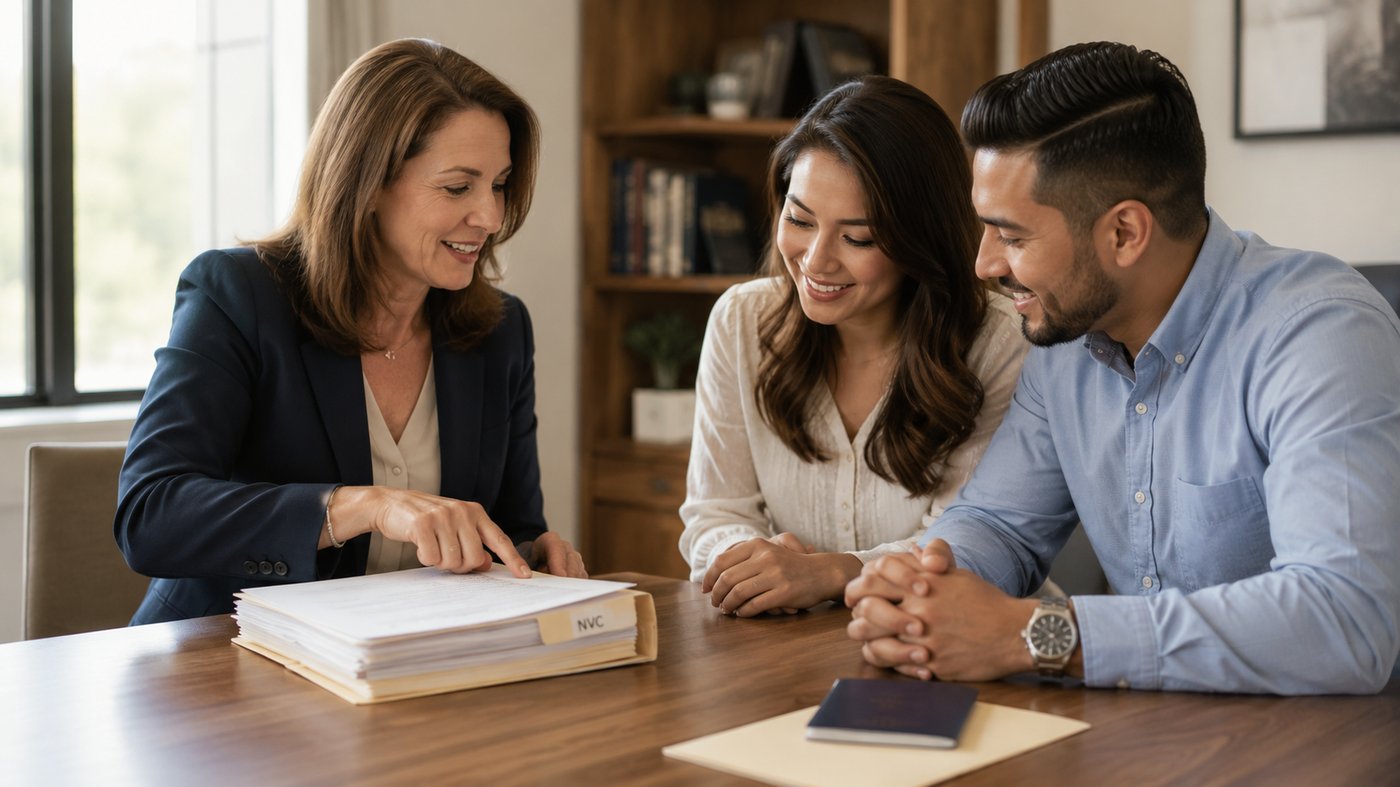
Civil documents
These prove who your relative is and their family history:
- Valid passport biographic (photo) page
- Birth certificate
- Marriage certificate (if married)
- Divorce decrees or death certificates for any prior marriages—the applicant's and, where relevant, the spouse's
- Police, court, or prison records where the destination country requires them
- Military records, if the applicant served
Financial documents
These show the relative will be supported and won't become a public charge:
- Form I-864, Affidavit of Support, signed by the petitioner
- The petitioner's most recent federal tax return or IRS tax transcript, with W-2s
- Proof of current income and employment (recent pay stubs, an employer letter)
Any document not in English needs a complete, certified English translation. Document requirements differ by country—what one consulate requires (such as a police certificate) another may not. See our I-864 guide for the affidavit of support, and check your country's specifics on the State Department's reciprocity and civil documents page. Requirements current as of July 2026.
The DS-260 immigrant visa application
The DS-260 is the immigrant visa application itself, filed online through the U.S. Department of State's Consular Electronic Application Center (CEAC). Each person immigrating files their own—so a spouse and two children would mean three DS-260s. Submitting it is what triggers the next step: the consulate uses it to move the case toward interview scheduling.
It asks for biographical details, address and work history, family information, and a long list of security and eligibility questions. Accuracy matters more than most people expect, because the answers carry straight into the interview. The consular officer has the completed DS-260 in front of them and will ask about it; an inconsistency between what's on the form and what's said at the window is exactly the kind of thing that slows a case down. We complete it with your relative carefully, the first time.
When a waiver is needed (I-601A)
Here's a situation we plan carefully around. If your relative spent time in the United States without lawful status and then departs to attend the consular interview, that earlier unlawful presence can trigger a bar on returning—three years if they were unlawfully present for more than 180 days, ten years if it was a year or more. The trap is that the bar is triggered by leaving, which is the very thing consular processing requires.
The I-601A provisional unlawful-presence waiver is designed to solve exactly this. It's filed and decided while the relative is still in the U.S., before they travel. If it's approved, they leave for the interview already knowing the unlawful-presence bar has been waived—rather than departing and hoping. The waiver is built on showing that a qualifying U.S. citizen or permanent resident relative would suffer extreme hardship if the family were kept apart. This is very workable for many families; it just has to be sequenced correctly.
If anyone in your case has spent time in the U.S. without status, talk to us before booking any travel. The order of these steps is the whole ballgame, and we'd rather assess it early than untangle it later.
The medical exam and the interview
Two things happen near the finish line, both in your relative's home country. First, they complete a medical exam with a panel physician—a doctor specifically approved by the U.S. embassy. (You can't use just any doctor; it has to be one on the embassy's approved list.) The exam covers a standard health check and required vaccinations, and the physician sends or hands over the results for the interview.
Then comes the consular interview at the embassy or consulate. Your relative should bring the originals of their civil documents, the appointment letter, their passport, the required photos, and the I-864 financial proof. The officer confirms the relationship is genuine, that the documents line up, and that no ground of inadmissibility applies. It's usually short—but it's the moment everything is checked. We prepare your relative on the likely questions and what to have in hand, so they walk in calm and ready rather than guessing.
After approval: entering the U.S. as a permanent resident
When the visa is approved, your relative receives an immigrant visa in their passport and, usually, a sealed packet. They use it to travel to the United States, and at the port of entry they are admitted as a lawful permanent resident—a green-card holder—from the moment they're inspected and admitted. There's no separate green-card interview back in the U.S.; the consular interview was it.
The physical green card follows by mail. To produce it, the USCIS Immigrant Fee is paid online—we recommend paying it before travel so the card isn't delayed. One important wrinkle: if the qualifying marriage was less than two years old on the day your relative is admitted, the green card is conditional and valid for two years. The couple then files Form I-751 together to remove those conditions in the 90-day window before it expires. We flag this at the start so it's a planned step, not a surprise. See our guide to removing conditions on residence (I-751).
Typical timeline
No two cases run on the same clock—a lot depends on the category and the specific consulate. With that said, here's a realistic shape of how the stages usually stack up.
| Stage | Typical range |
|---|---|
| I-130 petition (USCIS) | Immediate relatives ≈ 10–16 months; preference categories longer, plus the Visa Bulletin wait |
| NVC processing | ≈ 2–6 months to assemble and clear documents |
| Interview scheduling & medical | Varies by consular post |
| Total | Immediate relative often ≈ 12–20 months; preference varies widely |
Ranges are general estimates, current as of July 2026, and vary by post and category. The monthly Visa Bulletin drives the wait for preference categories. We'll give you a grounded estimate for your specific situation at the consultation.
What about the K-3 spouse visa?
The K-3 is a nonimmigrant visa created to let the spouse of a U.S. citizen wait inside the United States while the I-130 petition is pending, rather than waiting abroad. It sounds appealing, but in practice it rarely changes anything anymore—USCIS often finishes the I-130 around the same time, so most spouses simply go straight through consular processing, or, if they're already in the U.S. and eligible, through adjustment of status instead. We'll tell you honestly which path actually fits your situation rather than adding a step that doesn't help. Compare the two main routes in our guide to adjustment of status and our adjustment vs. consular processing breakdown.
A 2026 note on choosing your path
With USCIS treating adjustment of status as discretionary relief under its May 2026 memo (PM-602-0199), consular processing is the cleaner route for some families and the only route for others. We weigh both with you before filing. Read our side-by-side comparison or see the news breakdown.
Bring your family home
Flat fee, quoted up front. A real attorney from the I-130 through the consular interview. Free, confidential consultation.
Request a free consultation Call (718) 484-7510